Domain-Based Latent Personal Analysis (LPA) and Its Uses
LPA is an easy-to-use and fast domain-based spectral signature that can be used in a variety of domains and is tailored for big-data computations. It creates a strong and unique signature of both over-used and missing items that identify a user or a component in a domain. It can be used in a variety of domains, from textual to computational.
Paper: Mokryn, O., & Ben-Shoshan, H. (2020). “Domain-based Latent Personal Analysis and its use for impersonation detection in social media.” Accepted to User Modeling and User-Adapted Interaction (UMUAI), May 2021. arXiv:2004.02346. (PDF)
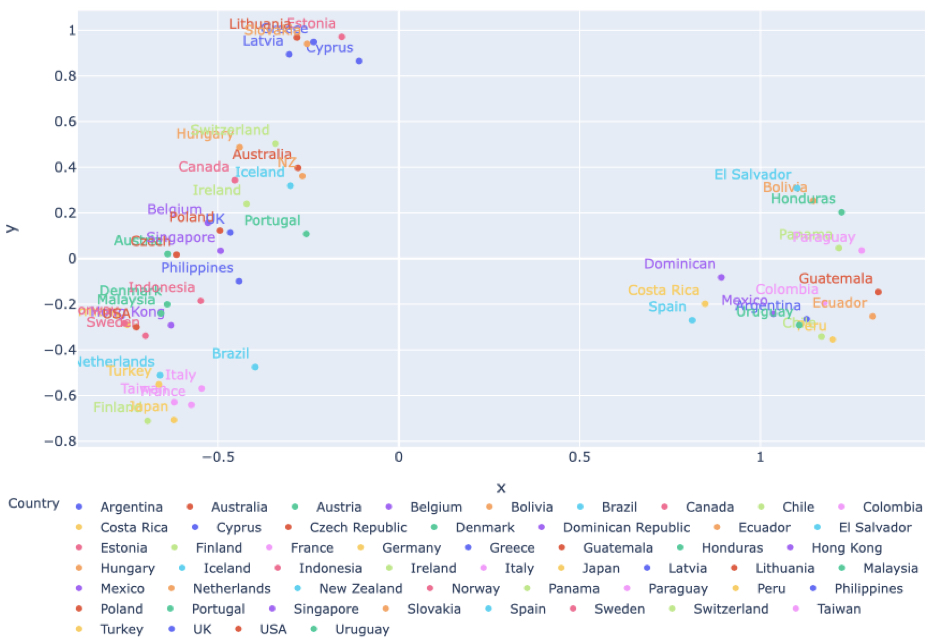
Zipf’s law defines an inverse proportion between a word’s ranking in a given corpus and its frequency in it, roughly dividing the vocabulary into frequent (popular) words and infrequent ones. Here, we stipulate that within a domain an author’s signature can be derived from, in loose terms, the author’s missing popular words and frequently used infrequent words. We devise a method, termed Latent Personal Analysis (LPA), for finding such domain-based personal signatures. LPA determines what words most contributed to the distance between a user’s vocabulary and the domain’s.
We identify the most suitable distance metric for the method among several and construct a personal signature for authors. We validate the correctness and power of the signatures in identifying authors and utilize LPA to identify two types of impersonation in social media: (1) authors with sockpuppet (multiple) accounts; (2) front-user accounts, operated by several authors. We validate the algorithms and employ them over a large-scale dataset obtained from a social media site with over 4000 accounts, and corroborate the results employing temporal rate analysis. LPA can be used to devise personal signatures in a wide range of scientific domains in which the constituents have a long-tail distribution of elements.
Impersonation on social media: sockpuppet accounts
LPA is fast and easy to implement at large scale. We deployed it over 4000 IMDb reviewer accounts to find sockpuppet accounts activated by a single author, performing a 4000x4000 similarity measure between all accounts’ LPA signatures. The full list of suspected sockpuppets is available.
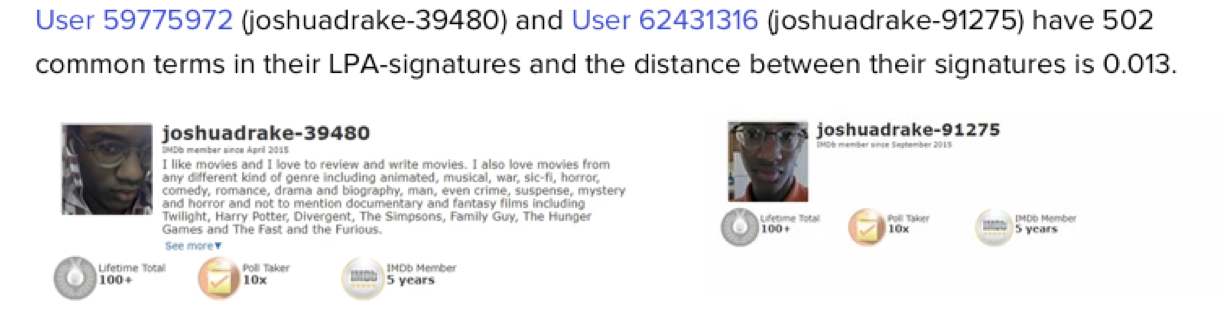
Example 1: User 59775972 (joshuadrake-39480) and User 62431316 (joshuadrake-91275) have 502 common terms in their LPA signatures, and the distance between their signatures is 0.013.
Example 2: User 24051675 (jpachar82) and User 53564354 (jasonpachar) have 584 common terms in their LPA signatures, and the distance between their signatures is 0.297.
Enjoy Reading This Article?
Here are some more articles you might like to read next:
- Unleashing the Power of Absence and Surprise
- Lab Celebration: Eran's RecSys 2025 Paper!
- Paper Alert: What Travelers Say vs. What They Rate
- Congratulations to Roi Alfassi — Part of His Master's Thesis Highlighted at HAI-GEN, IUI'2025!
- From Feelings to Fingerprints: A Talk at the Department of Communication Colloquium
- Reflections from the NetSciX'25 Keynote
- Interpretable Transformation and Analysis of Timelines through Learning via Surprisability (LvS)
- Harnessing AI for Creative Collaboration: Insights from Our Brainwriting Study
- Beyond R0: Unraveling COVID-19's Transmission Mysteries Through Temporal Network Analysis
- Talk at TAU's Cyber Week, June 26, 2023