Latent Personal Analysis (LPA) Published with SpringerNature in UMUAI
Glad to share a new paper in User Modeling and User-Adapted Interaction (UMUAI) with Hagit Ben-Shoshan, describing an exploration method in a complex domain: Latent Personal Analysis (LPA), with uses for user/entity modeling, impersonation detection in social media, music, and biology.
The method creates a domain, and a signature and distance for each entity comprising the domain. In language, within a domain, an author’s signature can be derived from, in loose terms, the author’s missing popular words and frequently used infrequent words. The distance and the signature are determined by increased distance for missing popular terms and decreased distance for the vast tail of rare words missing from the person’s vocabulary. Paraphrasing Debussy, style is the silence between the words: personal style is also measured by popular domain words missing from a person’s vocabulary.
How about applications?
Authorship attribution and the digital humanities.
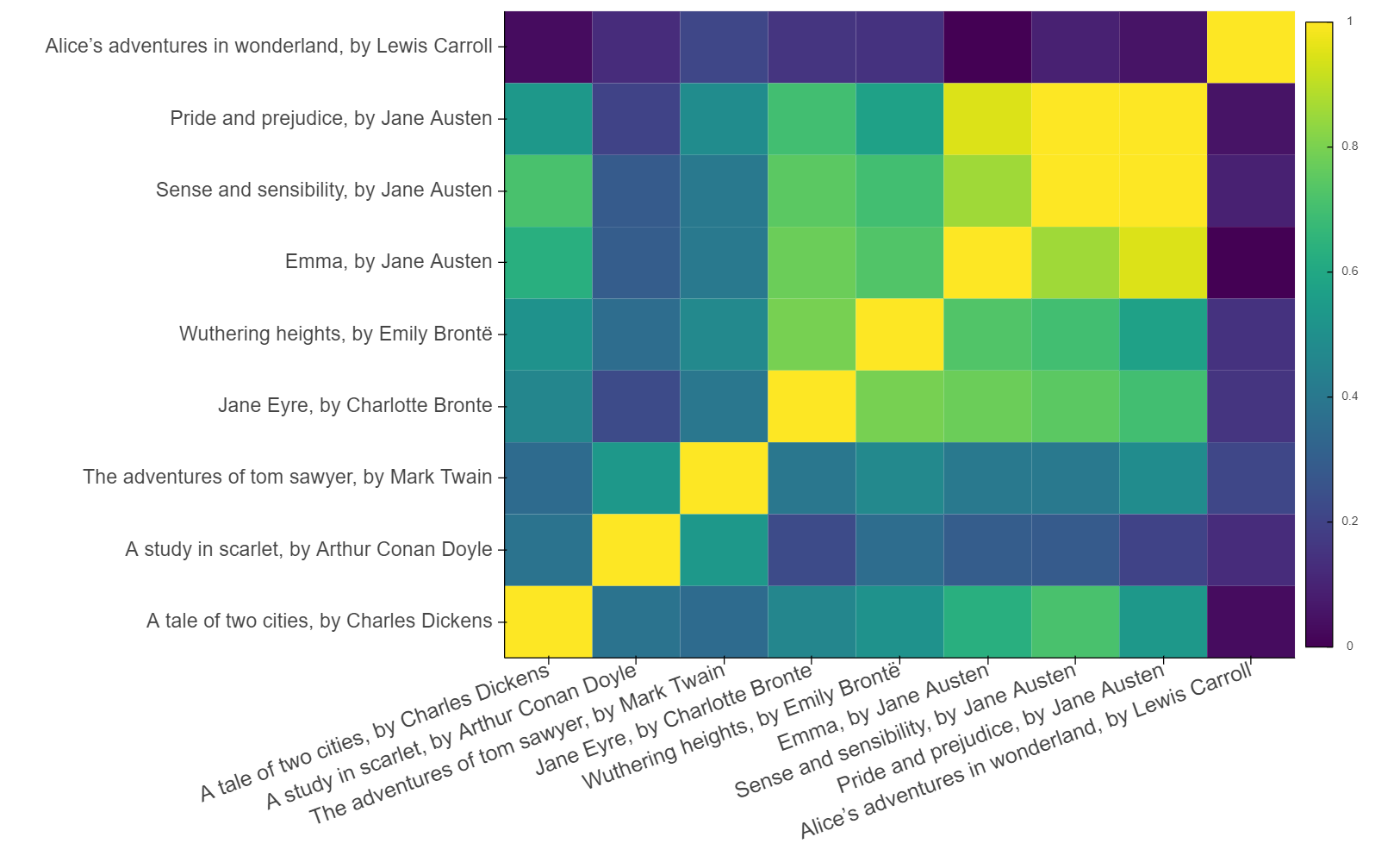
For example, a style heatmap of 19th-century writers, comparing books’ signature distances to determine similarity.
Qualitative exploration: the book Robinson Crusoe was taken as a domain, and each chapter as an entity.
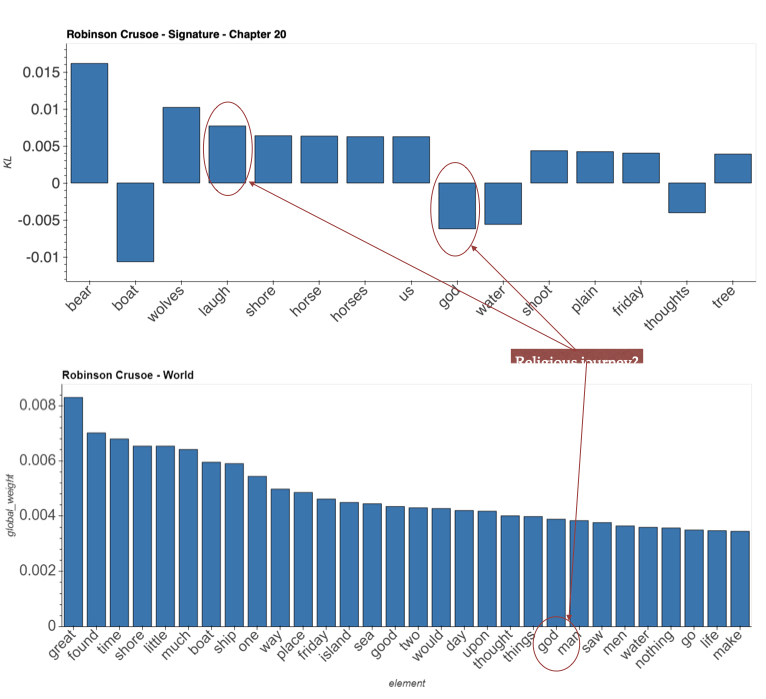
The lower panel shows the most frequent words in the book (not considering stopwords). Interestingly, God is one of the principal words in the domain, i.e., in the book. However, in the last chapter, the word God appears much less than in the rest of the book, while the word lough is much more frequent.
Social media user modeling. LPA can be used for better user modeling. For example, the signatures of two IMDb reviewers form a content-based exploration, exposing preferences as well as less preferred genres.
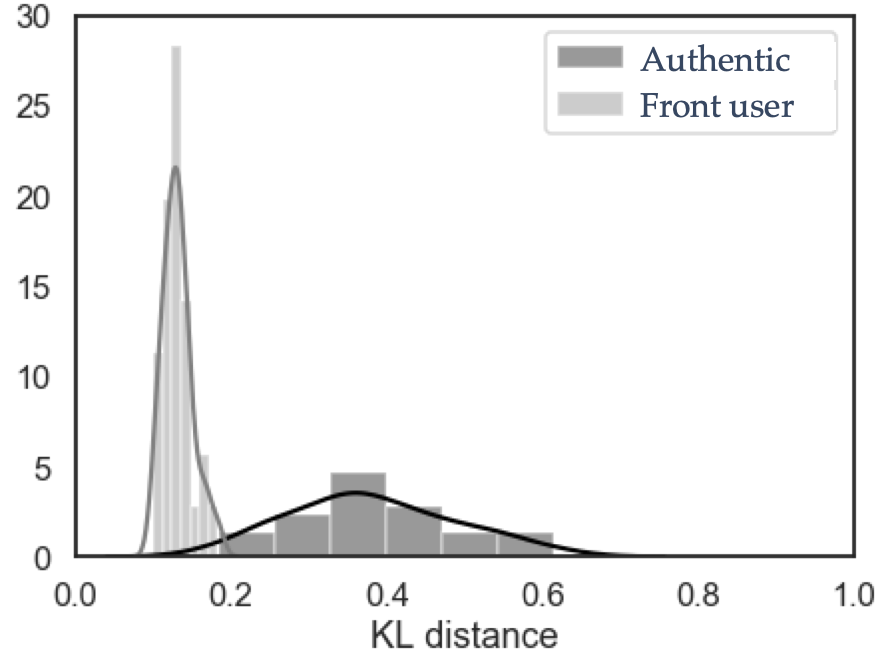
Impersonation detection. LPA can determine a form of sockpuppets, that is, several users authored by a single person. Interestingly, it can also flag a Front User account: a single account operated by multiple authors.
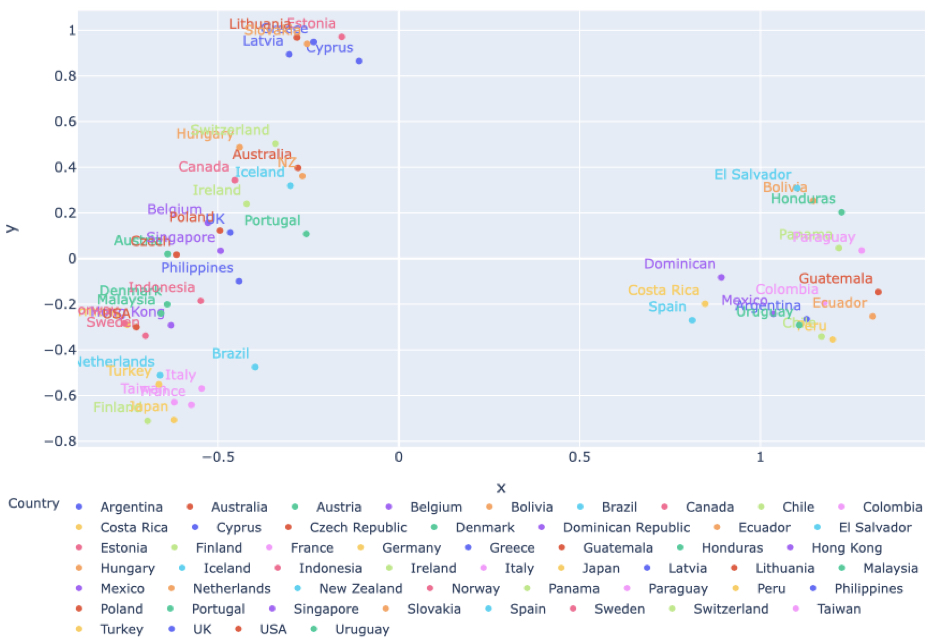
Music. Spotify’s 2017 dataset of all songs streamed in that year, and their listening frequency in each country, was the basis for an analysis that created an LPA distance and signature for each country. Countries that listen more to popular music have a lower distance — examples are Canada, Switzerland, and Australia, whose signatures are characterized by small differences in listening habits to hit songs. Countries distant from the domain are where local music is preferred, for example Turkey or Uruguay.
Biology. LPA was used to compare the spectral spread of sub-repertoires of B cell clones (B cells with a shared mother cell) within a person. We reiterated previous findings showing that gut and blood tissues have separate repertoires. We further identify a third branch of clonal patterns typical of the lymphatic organs (spleen, MLN, and bone marrow), separated from the other two categories. We also show that the spleen encompasses the closest picture of the entire repertoire, and person-popular clones are as popular in the spleen. The LPA biology paper with Uri Alon and Uri Hershberg.
Literature debates. Few have questioned the authorship of the Shakespearean poem “A Lover’s Complaint”. Creating a domain from all of Shakespeare’s writings, most have a typical distance — which is not the case for the poem in question.
Enjoy Reading This Article?
Here are some more articles you might like to read next:
- Unleashing the Power of Absence and Surprise
- Lab Celebration: Eran's RecSys 2025 Paper!
- Paper Alert: What Travelers Say vs. What They Rate
- Congratulations to Roi Alfassi — Part of His Master's Thesis Highlighted at HAI-GEN, IUI'2025!
- From Feelings to Fingerprints: A Talk at the Department of Communication Colloquium
- Reflections from the NetSciX'25 Keynote
- Interpretable Transformation and Analysis of Timelines through Learning via Surprisability (LvS)
- Harnessing AI for Creative Collaboration: Insights from Our Brainwriting Study
- Beyond R0: Unraveling COVID-19's Transmission Mysteries Through Temporal Network Analysis
- Talk at TAU's Cyber Week, June 26, 2023